News & Insights · 29 June 2026 · 5 min read
Rimfire Energy: 865 Days of EOT Lost to Defective Notices
The Federal Court held every extension notice invalid because none addressed one definitional element. The notices were served — they just didn't say enough.

Most time-bar disasters are about lateness: the notice that went out a week after the window closed. Rimfire Energy Pty Ltd v BSF Co Pty Ltd (No 2) [2025] FCA 384 is about something subtler and, for that reason, more dangerous. The extension notices in this case were served. There were six of them, claiming 865 days of extensions between them. Every one was held invalid — because none of them addressed a single element built into the contractual definition of the event being claimed. Timing compliance was not enough; the notices did not say what the contract required them to say.
The facts
Rimfire Energy, a Northern Territory electricity retailer, was the buyer under two materially identical power purchase agreements with BSF Co and HCPS Co, the owners of two generation projects in the Northern Territory with a combined capacity of 22 megawatts. The projects were due to reach commercial operation by mid-2021. Neither had achieved it by the time of the 2025 judgment — the owners blamed delays in grid connection driven by the network service provider's testing and approval programs.
The PPAs' extension regime (clause 5) required three things for a valid extension of time: an "Extension Event" as defined; demonstration that the owner was delayed, or likely to be delayed, in achieving commercial operation as a result; and a written claim submitted within 10 business days after the owner determined the full effects of the event. The Extension Event relied on — "Connection Works Delay" — carried a qualification inside its own definition: it applied only to the extent the delay was not caused by the owner or its EPC contractor.
Between April 2021 and August 2022 the owners submitted six EOT claims totalling 865 days. The notices pointed at the network provider's conduct, but with sparse particulars — and, critically, with no explanation or evidence that the delay was not attributable to the owners or their EPC contractor, and nothing evidencing when the "full effects" determination that started the 10-day clock had been made.
In November 2022 Rimfire invoiced each owner $1.4 million in delay damages — the contractual cap, representing only six months of delay — against what would, by the time of judgment, be roughly four years. An earlier decision ([2024] FCA 602) had enforced the PPAs' "pay now, argue later" regime, requiring interim payment of half. The validity fight came to judgment in 2025.
The issue
Were the EOT notices valid where they asserted a Connection Works Delay but did not address the definitional carve-out — that the delay was not caused by the owner or its EPC contractor? More broadly: how literally will a court read the content requirements of an extension regime drafted as a condition precedent?
What the Federal Court held
O'Callaghan J held all six EOT claims invalid, with the consequence that Rimfire recovered the full capped delay damages from each respondent, plus interest. The core of the reasoning, as the judgment put it, was that the absence of any explanation, supported by evidence, that the delay claimed was not caused by the EPC contractor or the owner was fatal to the validity of the EOTs. The qualification lived inside the definition of the Extension Event itself; a notice that did not engage with it had not established that an Extension Event existed at all. The 10-business-day requirement was construed strictly as part of the same machinery: a claim made outside it, or that failed to demonstrate when its clock started, did not comply.
It is a clean illustration of a principle Australian courts have applied to construction EOT regimes for decades — CMA Assets Pty Ltd v John Holland Pty Ltd [No 6] [2015] WASC 217 being the standing example of strict enforcement however harsh the result. Rimfire extends the discipline from "serve it on time" to "make it say everything the clause requires".
What this means in practice
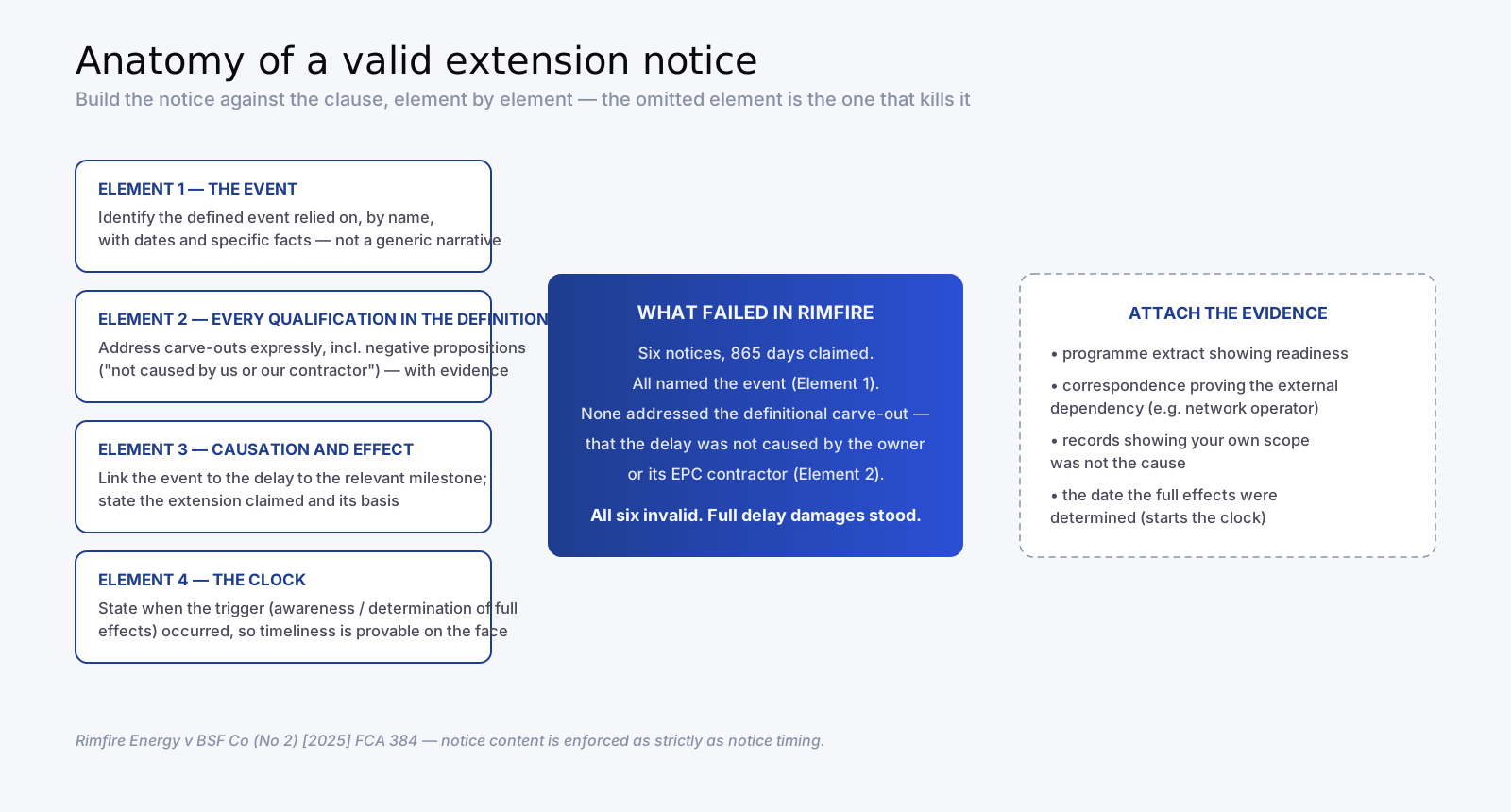
- Draft notices against the definition, element by element. Take the clause apart: the event definition (including every qualification and carve-out), the causation requirement, the particulars requirement, the timing trigger. The notice should visibly answer each one. Rimfire's notices failed on an element the drafters probably read past — a negative proposition ("not caused by us or our contractor") that the claimant had to affirmatively address.
- Negative elements need evidence, not assertion. Where the definition turns on what did not cause the delay, the notice needs the supporting material: the contractor's programme showing readiness, correspondence showing the external dependency, records demonstrating the claiming party's own house was in order.
- Anchor the clock with your own records. Where time runs from the claimant's determination of "full effects" (or awareness, or similar), the notice should state when and how that point was reached. Silence invites the argument that the clock started earlier and the claim is out of time.
- Renewables and infrastructure teams: your PPA is a construction contract for this purpose. Grid-connection delay is now one of the most common sources of Australian energy disputes, and PPA extension regimes are being enforced exactly like construction EOT clauses. The same notice discipline — registers, triggers, templates, evidence packs — applies.
- The cap can save you; the notice regime decides who needs saving. The owners' liability was capped at six months' delay damages against four years of actual delay. Caps and exclusions did real work here — but only after the notice failures had put the owners on the wrong side of the ledger.
Key takeaways
- All six EOT claims, totalling 865 days, were held invalid for failing to address a definitional element — that the delay was not caused by the owner or its EPC contractor (Rimfire (No 2) [2025] FCA 384).
- Notice content is enforced as strictly as notice timing under conditions-precedent regimes.
- Address every element of the event definition, evidence negative propositions, and state when the notice clock started.
- The discipline applies beyond construction contracts — PPAs and offtake agreements are litigated the same way.
This article is general information only and is not legal advice. For advice on a specific contract or dispute, seek legal counsel or contact Sumit Consulting for commercial and claims advisory support.