News & Insights · 10 August 2026 · 6 min read
Adjudication Under NSW SOPA, Step by Step: From Payment Claim to Determination
The deadlines are unforgiving, the pathways are precise, and a one-day error kills jurisdiction. The full NSW adjudication sequence, mapped.

Adjudication under the Building and Construction Industry Security of Payment Act 1999 (NSW) routinely turns months of payment dispute into a determination in five to six weeks. It does so by trading procedure for speed — which means the procedure that remains is strict, and the deadlines are jurisdictional. A one-day error can kill the application; a missed notice can kill the right to apply at all. This is the sequence, step by step, on the Act's own calendar: business days exclude weekends, public holidays, and 27–31 December (s 4).
Step 0 — The claim and the schedule set the pathway
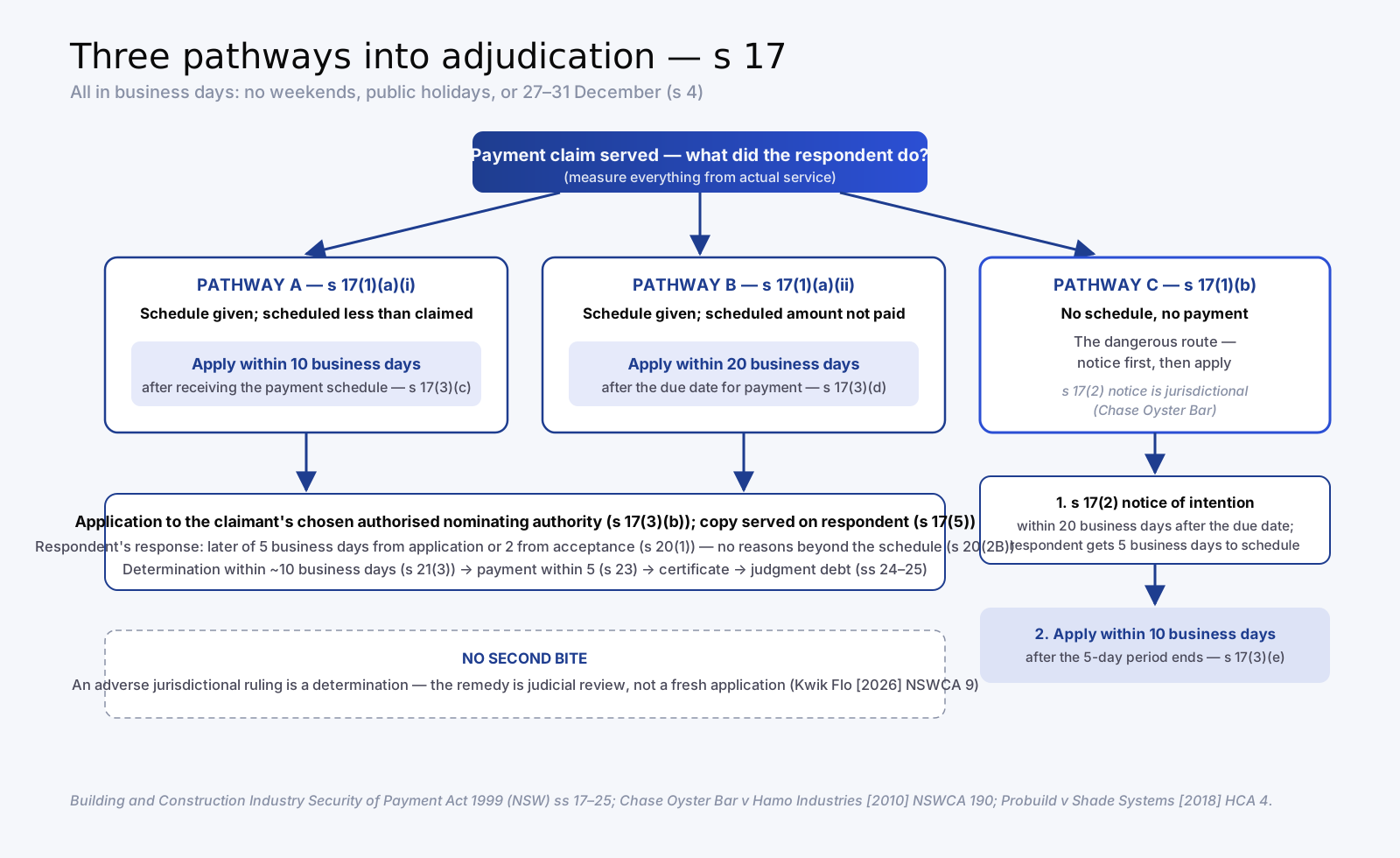
Everything keys off two documents: the payment claim and the payment schedule (or its absence). There are three routes into adjudication under s 17(1), each with its own clock:
- Pathway A — schedule provided, amount disputed (s 17(1)(a)(i)): the scheduled amount is less than the claimed amount. Apply within 10 business days after receiving the payment schedule (s 17(3)(c)).
- Pathway B — schedule provided, but not paid (s 17(1)(a)(ii)): the respondent scheduled an amount and failed to pay it by the due date. Apply within 20 business days after the due date (s 17(3)(d)).
- Pathway C — no schedule, no payment (s 17(1)(b)): the most dangerous route. Before applying, the claimant must notify the respondent in writing, within 20 business days after the due date, of its intention to adjudicate — and give the respondent 5 business days to provide a schedule after all (s 17(2)). Only then may the claimant apply, within 10 business days after the end of that 5-day period (s 17(3)(e)).
The s 17(2) notice is jurisdictional: Chase Oyster Bar Pty Ltd v Hamo Industries Pty Ltd [2010] NSWCA 190 establishes both that compliance with the timeframe is a precondition to a valid determination and that the Supreme Court will review determinations for jurisdictional error. Picking the wrong pathway, or miscounting any of these windows, is the single most common way strong claims die.
Step 1 — Choose the authority and assemble the application
The application goes in writing to an authorised nominating authority chosen by the claimant (s 17(3)(b)), with the prescribed fee, and a copy served on the respondent (s 17(5)). The choice of ANA is the claimant's only forum decision — make it deliberately, not by habit.
Assembly is where adjudications are won. The adjudicator may consider only the Act, the contract, the claim and the application's duly made submissions, the schedule and the response, and the results of any inspection (s 22(2)) — so the application must be self-sufficient:
- Address every reason in the payment schedule, one by one. The respondent is locked to those reasons (s 20(2B)); your application should leave none of them standing unanswered.
- Prove the basics: the contract, the work, service dates and methods, the pathway entitlement and its timeline — exhibit the transmittal records.
- Build the quantum from records: claim summaries tied to the contract structure, variation registers and directions, programme extracts, photographs, invoices. An adjudicator with 10 business days does not reconstruct your claim — present it finished.
- Anticipate jurisdiction. If there is any argument about the contract, the claim's validity or the pathway, deal with it squarely. An adverse jurisdictional ruling is a "determination" — there is no second application to a different ANA (Kwik Flo Pty Ltd v SE Ware Street Dev Pty Ltd [2026] NSWCA 9); the remedy is judicial review.
Step 2 — Appointment and the respondent's response
The ANA refers the application to an adjudicator, who accepts by notice to both parties (s 19). The respondent may lodge an adjudication response within 5 business days after receiving the application or 2 business days after the adjudicator's acceptance, whichever is later (s 20(1)) — but only if it provided a payment schedule in time (s 20(2A)), and it cannot include reasons for withholding payment not in that schedule (s 20(2B)).
For respondents, this is the moment the schedule's quality is repaid or punished. For claimants, any response that strays beyond the schedule's reasons should be called out in a request to the adjudicator to disregard it.
Step 3 — The determination
The adjudicator determines the application as expeditiously as possible and within 10 business days after the response is lodged or due — extendable only by agreement of the parties (s 21(3)). The determination states the adjudicated amount, the due date and interest. Adjudicators must decide within the parties' submissions; deciding on an unargued basis is a denial of procedural fairness reviewable in the narrow class of cases A-Civil Aust Pty Ltd v Ceerose Pty Ltd [2024] NSWCA 7 represents.
Step 4 — Payment and enforcement
The respondent must pay the adjudicated amount within 5 business days after the determination is served, or by the adjudicated date (s 23). If it doesn't, the claimant obtains an adjudication certificate from the ANA (s 24) — interest and the respondent's unpaid share of adjudication fees can be added — and files it as a judgment for a debt with an affidavit of non-payment (s 25). A respondent seeking to set that judgment aside cannot raise contract defences or challenge the determination, and must first pay the unpaid adjudicated amount into court as security (s 25(4)). Review of the determination itself survives only for jurisdictional error (Probuild Constructions (Aust) Pty Ltd v Shade Systems Pty Ltd [2018] HCA 4).
What this means in practice
- Map the pathway and the dates on day one — in writing, against the Act's business-day calendar, with the December exclusions marked. Then build the programme backwards from the application deadline.
- Prepare the application before you need it. The 10-business-day windows are too short for cold starts. The claim file — contract, service evidence, substantiation, schedule-reasons matrix — should exist as a living bundle from the moment the claim is served.
- Treat the s 17(2) notice as sacred. On the no-schedule pathway, the notice's timing and content are jurisdictional. Serve it early in the 20-day window, keep proof, and diarise the 5-day grace period precisely.
- One application, fully loaded. There is no second adjudicator and no supplementing the record later. Every alternative basis, every jurisdiction answer, every piece of substantiation goes in now.
- Respondents: your leverage was spent at the schedule stage. The response window is for executing what the schedule preserved — which is why the schedule discipline in our companion guide matters more than anything done during the adjudication itself.
Key takeaways
- Three pathways, three clocks: 10 business days from the schedule; 20 from the unpaid due date; or the s 17(2) notice route with its layered 20/5/10-day sequence — all jurisdictional (Chase Oyster Bar [2010] NSWCA 190).
- The adjudicator decides on the documents (s 22(2)); applications must be self-sufficient and answer every schedule reason.
- Respondents are confined to their payment schedule reasons (s 20(2B)); determinations land within ~10 business days and convert to judgment debts fast (ss 21(3), 23–25).
- No second bite (Kwik Flo [2026] NSWCA 9); review only for jurisdictional error (Probuild [2018] HCA 4).
This article is general information only and is not legal advice. For advice on a specific contract or dispute, seek legal counsel or contact Sumit Consulting for commercial and claims advisory support.