News & Insights · 26 August 2026 · 4 min read
Choosing a Delay Analysis Method: A Practical Guide to the SCL Protocol Options in Australia
Six recognised methods, no presumptive winner, and courts that punish method-first thinking. How to choose the analysis your records can actually carry.

Ask three delay analysts to assess the same project and you may get three different answers — not because anyone is dishonest, but because they chose different methods, and the method shapes the answer. The Society of Construction Law's Delay and Disruption Protocol (2nd edition, 2017) catalogues six method families, from impacted as-planned through windows analyses to collapsed as-built. What it cannot do is confer authority on any of them: Australian courts have said that appearing in the Protocol does not, by itself, give a method standing. Method selection is a judgement call, and it is increasingly the judgement on which delay claims live or die.
What the courts have actually said
In White Constructions Pty Ltd v PBS Holdings Pty Ltd [2019] NSWSC 1166, the parties' experts ran an as-planned versus as-built windows analysis and a collapsed as-built analysis respectively — both Protocol methods. Hammerschlag J, acting on the opinion of the court-appointed adviser, found neither method appropriate (at [191], [195]), accepting that "the fact that a method appears in the Protocol does not give it any standing, and the fact that a method, which is otherwise logical or rational, but does not appear in the Protocol, does not deny it standing" (at [191]). The court engaged its own adviser, found the introduced complexity "a distraction" (at [26]), and decided causation by "paying close attention to the facts", the common-law common-sense approach to causation (at [196]–[197]). The claim failed for want of breach (at [179]). On the delay question, the site diary did not show the alleged delay path (at [206], [212]).
The lesson: the Protocol is a vocabulary and a benchmark, not a rulebook, and every method ultimately answers to the records and to common-sense causation.
The real selection criteria
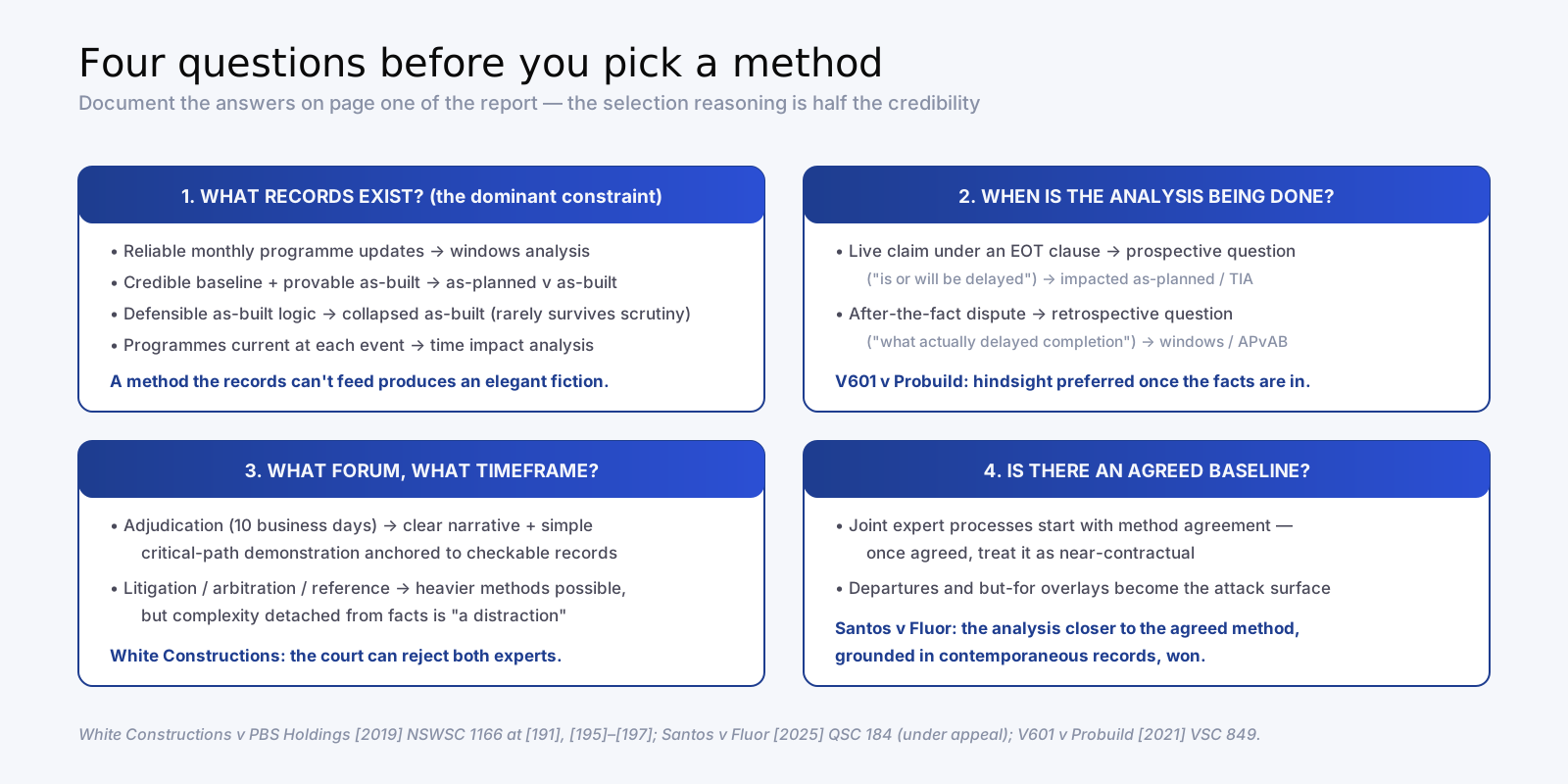
The honest way to choose a method is to ask four questions before opening the planning software:
1. What records exist? This is the dominant constraint. A windows analysis needs reliable, contemporaneous programme updates across the period. An as-planned versus as-built comparison needs a credible baseline and a provable as-built. A collapsed as-built needs an as-built programme with defensible logic — the Achilles heel White Constructions exposed. Time impact analysis needs programmes current at each delay event. Choosing a method the records cannot feed produces an elegant fiction, and courts have shown they will call it that.
2. When is the analysis being done? Prospective methods (impacted as-planned, time impact analysis) suit live-project EOT assessment — they answer "what delay will this event likely cause", which is the contractual question under most EOT clauses at the time of claim. Retrospective methods (windows, as-planned versus as-built, collapsed as-built) suit after-the-fact disputes — they answer "what actually delayed completion". Confusing the two questions is a recurring expert error; V601 Developments Pty Ltd v Probuild Constructions (Aust) Pty Ltd [2021] VSC 849 saw the court prefer retrospective analysis as "more practical and more accurate" once the facts were in.
3. What forum, what timeframe? An adjudicator with ten business days cannot digest a fully-logic-linked windows analysis across forty programme updates. Adjudication rewards a clear, records-anchored narrative with a simple critical-path demonstration. Litigation and arbitration can carry heavier methods.
4. What does the other side's programme discipline allow? Joint expert processes increasingly begin with method agreement. Once agreed, treat the baseline as near-contractual: departures become the attack surface.
What this means in practice
- Open every expert report with the selection reasoning. One page: the methods considered, the records available, why this method fits this dispute. An analysis that explains its own choice is harder to dismiss as advocacy — and forces the discipline White Constructions demands.
- Lead with the story, corroborate with the model. Courts decide causation on what happened on the ground. The analysis quantifies and tests the narrative the records tell; it cannot substitute for it. If the site diary doesn't show the delay path, no method will save the claim.
- Protect the records pipeline during delivery. Monthly programme updates actually statused, a baseline kept current through approved EOTs, daily records capturing crew locations and the reasons for idle time. The cheapest delay-analysis decision is made on site, every day, years before any dispute.
- Match the method to the contractual question on live claims. Most EOT clauses ask a prospective question at the time of the event ("is or will be delayed"). Run the prospective analysis for the claim, and preserve the data for the retrospective one you may need later — they are different products.
- In adjudication, simplify without becoming simplistic. A windows summary with three or four clearly evidenced windows, anchored to records the adjudicator can check, beats both a bare assertion and an unreviewable mega-model.
Key takeaways
- No delay method has presumptive standing in Australia; the Protocol is a benchmark, not a rulebook (White Constructions at [191]).
- Select on four criteria: records available, prospective vs retrospective question, forum constraints, and any agreed baseline — then document the selection reasoning.
- Every method answers to common-sense causation and contemporaneous records — the site diary outranks the software.
This article is general information only and is not legal advice. For advice on a specific contract or dispute, seek legal counsel or contact Sumit Consulting for commercial and claims advisory support.