News & Insights · 19 August 2026 · 6 min read
Extension of Time Under AS 4000: Getting Clause 34 Right
Two separate documents, two 28-day clocks, a deemed-approval trap for principals — and a reserve power that can save a late claim. Clause 34, properly read.

Clause 34 of AS 4000-1997 is persistently misadministered, usually because site teams treat it as one obligation ("send the EOT") when it is actually a sequence of distinct documents, definitions and clocks, several of which run against the principal as well as the contractor. Here is the machinery as drafted, and where the amended versions you actually sign depart from it.
The notice and the claim are different documents
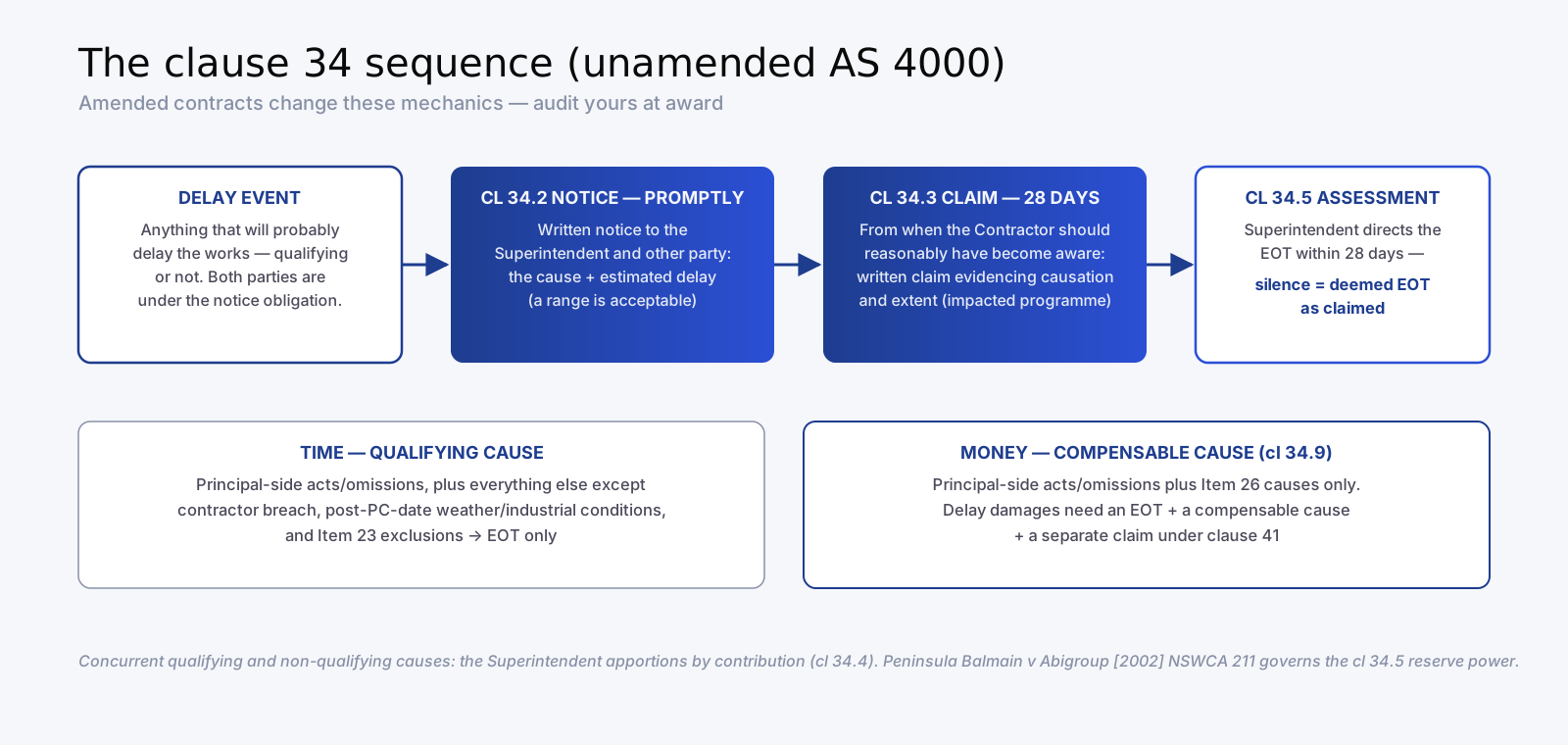
Clause 34.2 requires a party — note: the obligation is mutual, binding the principal too — that becomes aware of anything which will probably cause delay to the work to promptly give the superintendent and the other party written notice of that cause and the estimated delay. This is an early-warning notice: cause plus estimate, and an estimate is enough. It is not the claim.
Clause 34.3 is the claim. The contractor is entitled to the EOT the superintendent assesses if the contractor is or will be delayed in reaching practical completion by a qualifying cause of delay, and gives the superintendent a written claim within 28 days of when the contractor should reasonably have become aware of that causation occurring, evidencing the facts of causation and of the delay — including its extent. Two features deserve attention. The clock runs from when you should reasonably have been aware, not from when the delay ends or when you got around to quantifying it. And the claim must evidence causation and extent — in practice, an impacted programme showing the critical-path effect, not an assertion. For continuing delay, a further promptly-given claim is required as the delay extends.
Qualifying gets you time; compensable gets you money
The clause 1 definitions do the real allocation work. A qualifying cause of delay is (a) any act, default or omission of the superintendent, the principal or its consultants, agents or other contractors; or (b) anything else other than a breach or omission by the contractor, industrial conditions or inclement weather occurring after the date for practical completion, and any causes the parties list in Item 23. That limb (b) sweep-up surprises people: in the unamended form, weather and industrial action before the date for practical completion qualify for time unless Item 23 excludes them.
A compensable cause is narrower — the principal-side acts and omissions, plus anything listed in Item 26. The split drives clause 34.9: delay damages are payable only for days the subject of an EOT for a compensable cause, and only where the contractor makes a separate costs claim under clause 41. Time and money are different applications under different clauses — bundling them is a classic administration error.
The superintendent's 28 days — and the deemed EOT
Under clause 34.5, the superintendent must give a written direction evidencing the assessed EOT within 28 days of receiving the claim. Fail, and "there shall be a deemed assessment and direction for an EOT as claimed" — the full claim, granted by silence. In the unamended form this is the contractor's most underused protection and the principal's most dangerous trap; diarising the superintendent's deadline should be standard practice on both sides of the contract.
The same clause holds the famous reserve power: the superintendent may at any time before the final certificate direct an EOT, whether or not the contractor claimed or was entitled to one. Peninsula Balmain Pty Ltd v Abigroup Contractors Pty Ltd [2002] NSWCA 211 (decided under the AS 2124 equivalent) held that this kind of unilateral power must be exercised honestly and impartially — and may fall to be exercised in the contractor's favour even where its own claim is time-barred. That is why so many amended contracts recast the power as exercisable solely for the principal's benefit. Which version is in your contract changes your strategy when a claim has missed its window.
Assessment under clause 34.4 has its own discipline: where qualifying and non-qualifying causes of delay overlap, the superintendent apportions the delay according to each cause's contribution — a materially more contractor-friendly treatment of concurrency than AS 2124's. The superintendent must also disregard the contractor's ability to accelerate, but must have regard to prevention and mitigation of the delay not effected by the contractor.
The contract you signed is not AS 4000
Almost no Australian project runs on unamended AS 4000, and clause 34 is where the surgery concentrates. The recurring amendments: express condition-precedent ("time-bar") language added to clause 34.3, where the unamended form leaves room for argument; the 28 days shortened; the clause 34.5 deemed assessment deleted; the reserve power neutered; delay damages capped or fixed at scheduled rates; and the limb (b) sweep-up narrowed via Item 23. In the unamended form, cl 34.3 makes entitlement conditional on a claim within 28 days, but cl 41.2 says a failure to communicate a claim in accordance with the contract neither bars nor invalidates it. Amended forms usually remove that doubt. Each amendment changes the risk profile of the same factual delay. (Note also that a new edition — AS 4000:2025 — has now been published; confirm which edition and amendments actually govern your contract before applying any of this.) Clause numbers and some wording differ in AS 4000:2025; check the edition before relying on these references.
What this means in practice
- Run the two documents as two systems. A prompt 34.2 notice on awareness (cause plus estimated delay), then the evidenced 34.3 claim inside 28 days. Issuing only one, or merging them, leaves entitlement exposed — especially under amended condition-precedent versions.
- Anchor the 28 days to the awareness trigger, in writing. Record in the claim when the contractor became aware of the causation; silence invites the argument the clock started earlier. Time bars are enforced strictly (CMA Assets Pty Ltd v John Holland Pty Ltd [No 6] [2015] WASC 217), and content failures are as fatal as late ones (Rimfire Energy Pty Ltd v BSF Co Pty Ltd (No 2) [2025] FCA 384).
- Evidence extent with the programme. "Evidencing the facts of causation and of the delay (including extent)" means a programme-based demonstration of critical-path effect, kept contemporaneously — the records lesson of White Constructions Pty Ltd v PBS Holdings Pty Ltd [2019] NSWSC 1166 applies at claim stage, not just in court.
- Principals and superintendents: diarise your own 28 days. The deemed EOT is self-executing. A claim left in an inbox is a claim granted.
- Map your amendments before the first delay. Which clause 34 do you actually have? Time-barred or not, deemed approval or not, reserve power for whom, what's in Items 23 and 26 — one page, at award, for every contract.
Key takeaways
- Clause 34.2 (prompt notice of probable delay) and clause 34.3 (evidenced claim within 28 days of reasonable awareness) are separate, sequential obligations — and 34.2 binds the principal too.
- Qualifying causes earn time; only compensable causes earn money, via a separate clause 41 claim (cl 34.9).
- The superintendent has 28 days to assess, failing which the EOT is deemed as claimed (cl 34.5) — and the unamended reserve power must be exercised impartially (Peninsula Balmain).
- Concurrent qualifying and non-qualifying causes are apportioned under cl 34.4.
- Standard-form knowledge is not contract knowledge: audit the amendments, every time.
This article is general information only and is not legal advice. For advice on a specific contract or dispute, seek legal counsel or contact Sumit Consulting for commercial and claims advisory support.