News & Insights · 14 September 2026 · 5 min read
Global Claims: Why They Fail and What to Do Instead
Australia is stricter than England here: one unexcluded cause can sink the whole claim. The four things a global claim must prove — and the discipline that avoids needing one.

Every commercial manager has felt the temptation. The project lost money; the principal caused chaos all year; untangling which event caused which dollar looks impossible. So the claim becomes: here is everything that happened, here is our total overrun, the connection is obvious. That is a global claim — and in Australia it is the closest thing claims practice has to a known losing strategy. Understanding precisely why tribunals reject them is the best available training in what a winning claim looks like.
What a global claim is
A global claim alleges a composite loss from multiple events without demonstrating the causal link between each event and any specific portion of the loss — Byrne J's classic description in John Holland Construction & Engineering Pty Ltd v Kvaerner RJ Brown Pty Ltd (1996) 82 BLR 81 is of a claimant content to allege "a composite loss as a result of all of the breaches alleged". Its commonest species is the total cost claim: actual cost minus tender, with the whole gap attributed to the other side.
The Australian framework: four proofs and no apportionment
Kvaerner remains the leading Australian statement. Global claims are not absolutely prohibited — but they are pleadings of last resort attracting close scrutiny, and the total-cost variant requires the claimant to prove four things: that it could reasonably have performed within its tender allowance; that the defendant's events caused additional cost; that actual costs exceeded the allowance; and — the killer — that the defendant's events were the only causally significant factor in the overrun.
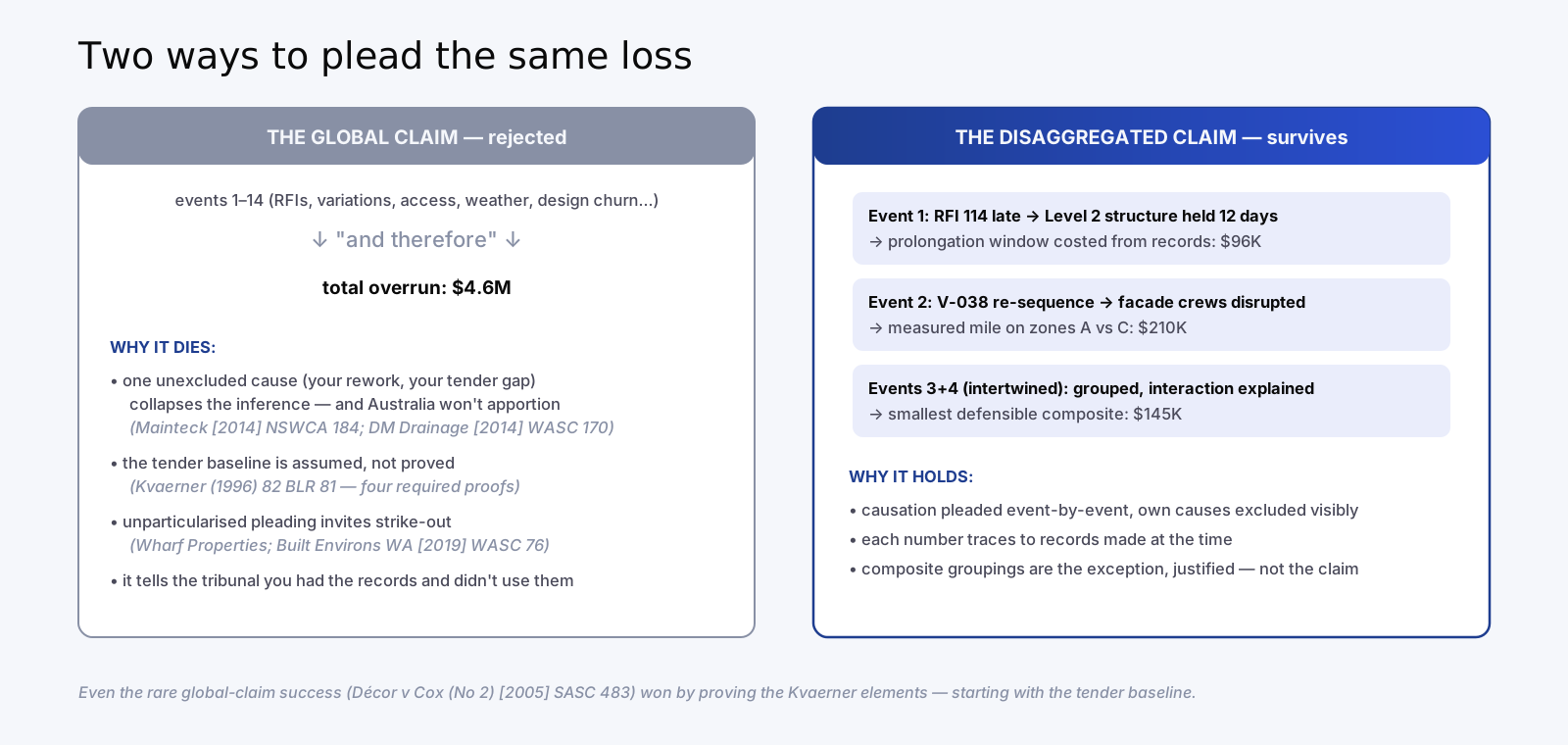
The New South Wales Court of Appeal hardened the position in Mainteck Services Pty Ltd v Stein Heurtey SA [2014] NSWCA 184: there are no special causation rules for construction cases, the claimant must exclude all other operative causes, and there is no "apportionment approach" under which a tribunal awards a fair share where only some causes are proved — "that is not the law". DM Drainage & Constructions Pty Ltd v Karara Mining Ltd [2014] WASC 170 makes the logic explicit: without excluding alternative causes, the causal inference simply cannot be drawn.
This is materially stricter than the English position. In Walter Lilly & Co Ltd v Mackay [2012] EWHC 1773 (TCC), Akenhead J held a claimant-caused contributing event merely reduces the global sum rather than dooming the claim. In Australia, post-Mainteck, the contaminating cause can defeat the lot. Importing Walter Lilly optimism into an Australian dispute is a category error.
And the attack can come before trial. Wharf Properties Ltd v Eric Cumine Associates (No 2) (1991) 52 BLR 1 established the pleading-deficiency strike-out; Built Environs WA Pty Ltd v Perth Airport Pty Ltd (No 2) [2019] WASC 76 applied it in modern form, striking out a $4.6M "modified total cost" claim that failed to identify why alternative causes were excluded — the supporting expert report, the court observed, "does nothing to unlock the continuing mystery" of how the loss arose.
Global claims can succeed: in Décor Ceilings Pty Ltd v Cox Constructions Pty Ltd (No 2) [2005] SASC 483 a subcontractor who tendered for fifteen weeks and spent forty on site succeeded globally — by actually proving the Kvaerner elements, starting with a realistic tender. The exception is instructive: it succeeded because it stopped being lazy.
Why they really fail
Strip the doctrine away and global claims fail for four practical reasons. The causation gap: the inference from "many events" to "this loss" collapses the moment the respondent points to any cause the claimant owns — weather, its own rework, an underpriced tender. Self-contamination: in a total cost claim, the claimant's own inefficiencies are necessarily buried in the global sum, and in Australia that can be fatal rather than merely deductive. The unproven baseline: the tender must itself be proved adequate — the very thing a money-losing project makes doubtful. And forensic surrender: presenting a global claim tells the tribunal the claimant either lacks the records to do better or chose not to use them — Walter Lilly itself warns tribunals will be "more sceptical" where direct linkage was available and not deployed.
What to do instead
The alternative is not heroic — it is structural, and it starts during delivery, not at claim time:
- Disaggregate by cause, not by month. Build the claim event-by-event: this RFI delay, these affected activities, this window of prolongation, these costs. Where events genuinely interact, group them into the smallest defensible clusters and explain the interaction — a reasoned composite for two intertwined causes is a different animal from a project-wide global sum.
- Run the delay-event register from day one. Cause ownership assigned in real time (principal-risk, contractor-risk, neutral) is precisely the evidence that lets you exclude alternative causes later — the Mainteck requirement that kills claims assembled retrospectively.
- Segregate costs while they're being incurred. Cost codes per event or work front for disrupted work, daywork records for changed work, time-related preliminaries tracked by period. The measured-mile and prolongation methods we cover separately all depend on this granularity.
- Prove the baseline early. Keep the tender build-up, productivity allowances and their basis. If the claim ever has to defend the proposition "we would have made money but for these events", the estimator's contemporaneous workings are the foundation (Décor succeeded on exactly this).
- If cornered into a composite claim, do it the hard way. Plead the claim type honestly, identify every causative event, demonstrate the exclusion of your own causes item by item, and carve out everything that can be directly linked. The Built Environs strike-out is the cost of skipping those steps.
Key takeaways
- A global claim asserts a composite loss without event-by-event causation; the total cost claim is its commonest, weakest form.
- Australia requires the claimant to exclude all other operative causes — and rejects apportionment (Kvaerner; Mainteck; DM Drainage). One unexcluded cause can sink everything.
- Strike-out is a live risk for unparticularised composite claims (Wharf Properties; Built Environs WA).
- The successful exception (Décor (No 2) [2005] SASC 483) proved the tender baseline and the Kvaerner elements — the exception that defines the rule.
- The real answer is upstream: delay-event registers, cost segregation and baseline proof during delivery make global claims unnecessary.
This article is general information only and is not legal advice. For advice on a specific contract or dispute, seek legal counsel or contact Sumit Consulting for commercial and claims advisory support.