News & Insights · 23 September 2026 · 6 min read
Latent Conditions: Notice, Entitlement and Risk Allocation Under Australian Contracts
The test is what a competent contractor should have anticipated — and the 28 days isn't a notice bar, it's a cost amputation. What the clause actually does, and what amendments do to it.

Few site events create faster commercial tension than the excavator hitting something the tender documents said wasn't there. Latent conditions claims sit at the junction of geotechnical fact, contractual machinery and tender-stage risk allocation — and they are routinely mishandled on all three fronts: notice given after the evidence is destroyed, entitlement assumed where the amendments deleted it, and the 28-day rule misread as a time bar when it is something subtler. Here is how the machinery actually works.
What qualifies: an objective test
Under the unamended AS 4000 (cl 25.1), latent conditions are physical conditions on the site or its near surrounds — including artificial things, excluding weather — that differ materially from what should reasonably have been anticipated by a competent contractor at the time of tender, assuming that contractor examined the information provided, made reasonable enquiries and inspected the site.
The test is objective, and the leading Australian authority shows both edges of it. In BMD Major Projects Pty Ltd v Victorian Urban Development Authority [2007] VSC 409 (upheld on appeal, [2009] VSCA 221), low quarry-floor levels qualified as a latent condition — a competent contractor without geotechnical expertise was not required to engage a specialist absent a red flag in the tender material. But oversized rock did not qualify — the contractor had priced a contingency and had not relied on the precision of the report. The question is never "did this surprise us"; it is "should a competent contractor, on this tender information, have anticipated it" — and your own tender workings (contingencies, assumptions, qualifications) will be Exhibit A on both sides of that argument.
The machinery: notice before disturbance, then a deemed variation
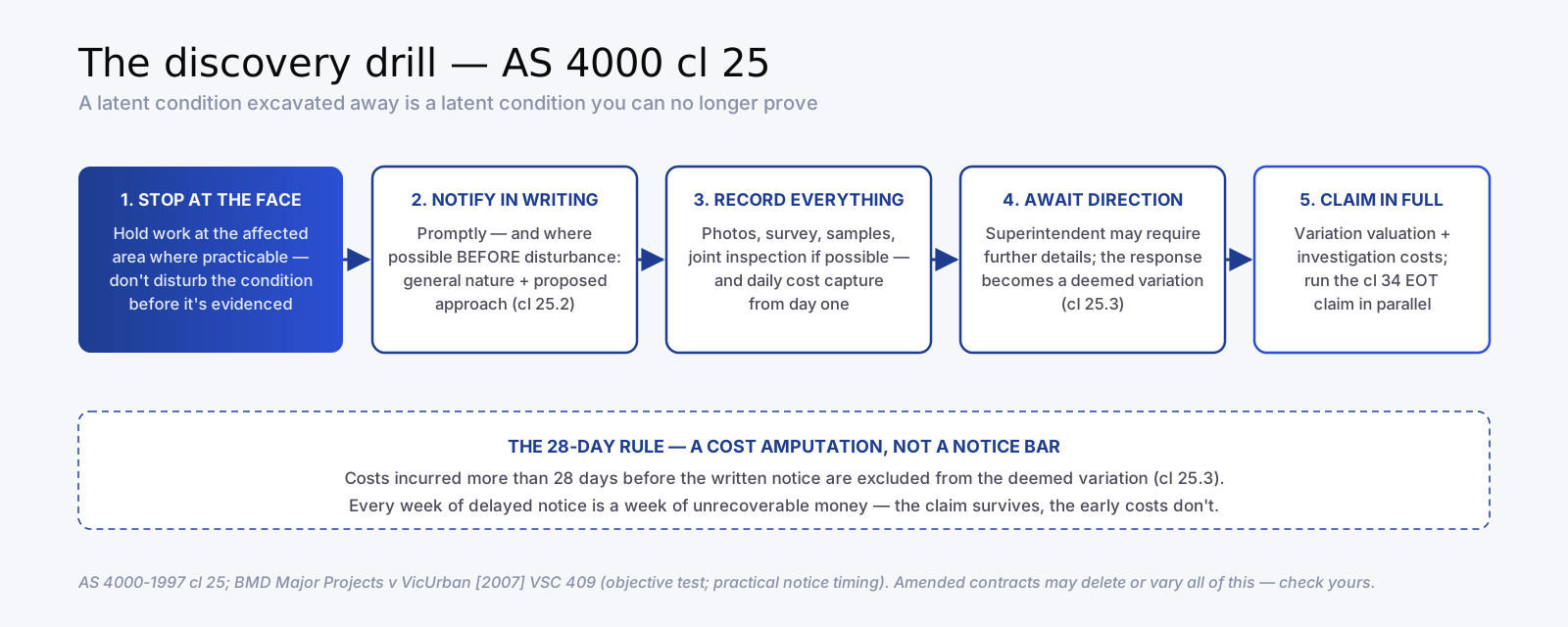
Clause 25.2 requires prompt written notice, where possible before the latent condition is disturbed, of the general nature of the condition. If the superintendent asks, the contractor must then give a written statement of the condition, how it differs, and the additional work, resources, time and cost it expects. The before-disturbance element is the operationally critical one: a latent condition excavated away is a latent condition you can no longer prove. BMD takes a practical view of timing (under a modified AS 2124-1992 cl 12.2, which required notice "forthwith"; AS 4000 says "promptly"). There, "forthwith" meant as soon as reasonably practicable in the circumstances, and verbal notice followed by written notice ten days later sufficed. But practicality is no licence for delay.
The entitlement (cl 25.3) is a deemed variation: the effect of the latent condition is valued through the variation machinery, including investigation costs. And here sits the misread rule: costs incurred more than 28 days before the written notice are excluded. The 28 days is not a notice bar that kills the claim — it is a rolling amputation of early costs. Every week of delayed notice is a week of unrecoverable money.
Time is clearer than the cost of time. Under unamended AS 4000, a qualifying cause of delay includes any cause other than the contractor's breach, post-completion weather or industrial conditions, and causes stated in Item 23. A latent condition will usually support an EOT unless Item 23 excludes it (cl 1). Delay damages are different: cl 34.9 pays them only for a compensable cause, which means a principal-side act or omission or a cause listed in Item 26. Claim the EOT on time under cl 34, and read Items 23 and 26 before assuming the cost of time follows.
What the amendments do — and the limit they can't cross
Almost no major-project contract leaves cl 25 intact. Design and construct deliveries in particular transfer ground risk wholesale: site information provided "for information only, not forming part of the contract", no-reliance acknowledgements, deemed site inspection, and outright deletion of the latent conditions clause. Priced or not, that transfer is generally effective — with one limit that no drafting can remove.
Misleading or deceptive conduct under s 18 of the Australian Consumer Law cannot be excluded. The leading construction authority is Abigroup Contractors Pty Ltd v Sydney Catchment Authority (No 3) [2006] NSWCA 282 (decided under the predecessor provision, TPA s 52): tender documents for the Warragamba Dam spillway represented that no plans of an outlet pipe existed; that was misleading, and the contractual provisions allocating site risk to the contractor could not defeat the statutory claim (appeal allowed and quantum remitted). The principle has old common-law roots too: Morrison-Knudsen International Co Inc v Commonwealth (1972) 46 ALJR 265 concerned a claim that pre-tender soil information materially understated the cobbles in Tullamarine's clays. Principals who curate, trim or sit on site information are not allocating risk; they are accumulating it.
The mature alternative, increasingly used on Australian tunnelling and major infrastructure, is the geotechnical baseline report: a contract document that sets measurable baseline ground conditions — worse than baseline is the principal's risk, within baseline the contractor's. It converts an unpriceable unknown into a priced line, which is what risk allocation is supposed to do.
What this means in practice
- Contractors: run the discovery drill. Stop work at the affected face where practicable; written notice before disturbance (general nature of the condition); photograph, survey and sample; record costs daily from day one; await direction. The drill protects both the evidence and the money — remember the 28-day amputation runs backwards from your notice.
- Preserve the tender record. Your estimator's assumptions, the site inspection notes, the questions asked at tender — these decide the "competent contractor" argument. A contingency priced against "some rock" will be read against you on rock claims (BMD's second limb); a clean reliance trail on the bore logs works for you.
- Read the amendments before pricing the job. If cl 25 is deleted or gutted, the ground risk is in your price or in your margin — there is no third place. Price the investigation that the risk transfer makes necessary, or qualify the tender.
- Principals: disclose completely or baseline it. Partial disclosure is the Abigroup trap. Either hand over everything you hold (with the usual non-warranty framing) or invest in a GBR and allocate against it. And treat incoming latent-condition notices as evidence-preservation events: inspect jointly, fast, before the face moves on.
- Victorian projects: the claims route widened. Since April 2026, latent-condition costs are no longer "excluded amounts" — they can travel through security of payment adjudication in Victoria, which makes the notice-and-records discipline above bankable rather than merely prudent.
Key takeaways
- The test is objective: what a competent contractor should reasonably have anticipated on the tender information (BMD v VicUrban).
- Notice goes in writing, promptly, and where possible before the condition is disturbed; the cl 25.3 entitlement is a deemed variation — with costs older than 28 days before notice excluded.
- Time is clearer than the cost of time: a latent condition will usually support an EOT under unamended AS 4000 unless Item 23 excludes it, but cl 34.9 delay damages need a compensable cause (a principal-side act or omission, or an Item 26 cause). Claim the EOT on time under cl 34.
- D&C amendments transfer ground risk effectively, but misleading site information defeats the transfer (Abigroup; ACL s 18) — and GBRs are the grown-up alternative.
This article is general information only and is not legal advice. For advice on a specific contract or dispute, seek legal counsel or contact Sumit Consulting for commercial and claims advisory support.