News & Insights · 12 August 2026 · 7 min read
Security of Payment Across Australia: NSW, Queensland, Victoria and WA Compared
Same idea, four different machines. The deadlines, traps and distinctive features of each state's regime, side by side — current to mid-2026.

Security of payment legislation exists in every Australian state and territory, and every version promises the same bargain: fast, interim payment decisions that keep cash moving down the contracting chain, with final rights preserved for later. But the machines that deliver that bargain differ — in claim timing, schedule deadlines, payment caps, adjudication windows and even what counts as a "business day". For commercial teams working across borders, those differences are not trivia: an assumption imported from your home state is a missed deadline waiting to happen. This is the east-and-west coast comparison as at mid-2026. Victoria changed materially in April 2026, and WA has an amendment bill in Parliament.
The four regimes at a glance
| | NSW (1999 Act) | Qld (BIF Act 2017) | Vic (2002 Act, as reformed 15 Apr 2026) | WA (2021 Act) | |---|---|---|---|---| | Claim entitlement | Last day of each named month (post-Oct 2019 contracts) | Reference dates retained; default last day of month | Last day of each month (reference dates abolished) | Last day of each named month | | Claim after termination | Yes — s 13(1C) | Termination date is final reference date (s 67(2)) | Yes | Yes — s 23(6) | | "Made under the Act" endorsement | Required (s 13(2)(c)) | Not required (s 68) | Required (s 14(2)(e)) | Required (s 24(1)(d)) | | Payment schedule deadline | Earlier of contract or 10 business days | Earlier of contract or 15 business days | Earlier of contract or 10 business days (s 15(4)); 5 business days after a s 18(2) notice (s 18(2A)) | Earlier of contract or 15 business days | | No schedule served | Liable for full claim; debt recovery, defences barred | Liable for full claim; also an offence; no adjudication response allowed | Liable for full claim | Liable for full claim; debt or adjudication, not both | | Payment terms cap | 15 business days head contract / 20 subcontract (s 11) | 15 business days head contract / 25 trade contracts (QBCC Act ss 67W, 67U) | Terms beyond 20 business days void (flat cap) | 20 business days head contract / 25 subcontract (s 20) | | Adjudication application | 10–20 business days depending on pathway (s 17(3)) | 20–30 business days depending on pathway (s 79) | 5 to 10 business days depending on pathway (s 18(3)) | 20 business days after entitlement arises (s 28) | | New reasons at adjudication | Barred (s 20(2B)) | Barred (s 82(4)) | Barred (post-reform) | Barred (s 34) | | Review mechanism | None (judicial review only) | None (judicial review only) | None — old limited review repealed | Yes — review adjudication, ±$200,000 thresholds, 5 business days to apply | | Unfair time-bar relief | No | No | Yes — s 13A (notice-based time bars, incl. security release) | Yes — s 16 (notice-based time bars) | | December pause | 27–31 Dec only | 22 Dec – 10 Jan | 22 Dec – 10 Jan | 22 Dec – 10 Jan |
Always check the current consolidation before acting — and note both the Victorian reforms (April 2026) and WA's pending Amendment Bill (before the Legislative Council as at June 2026).
What actually catches people
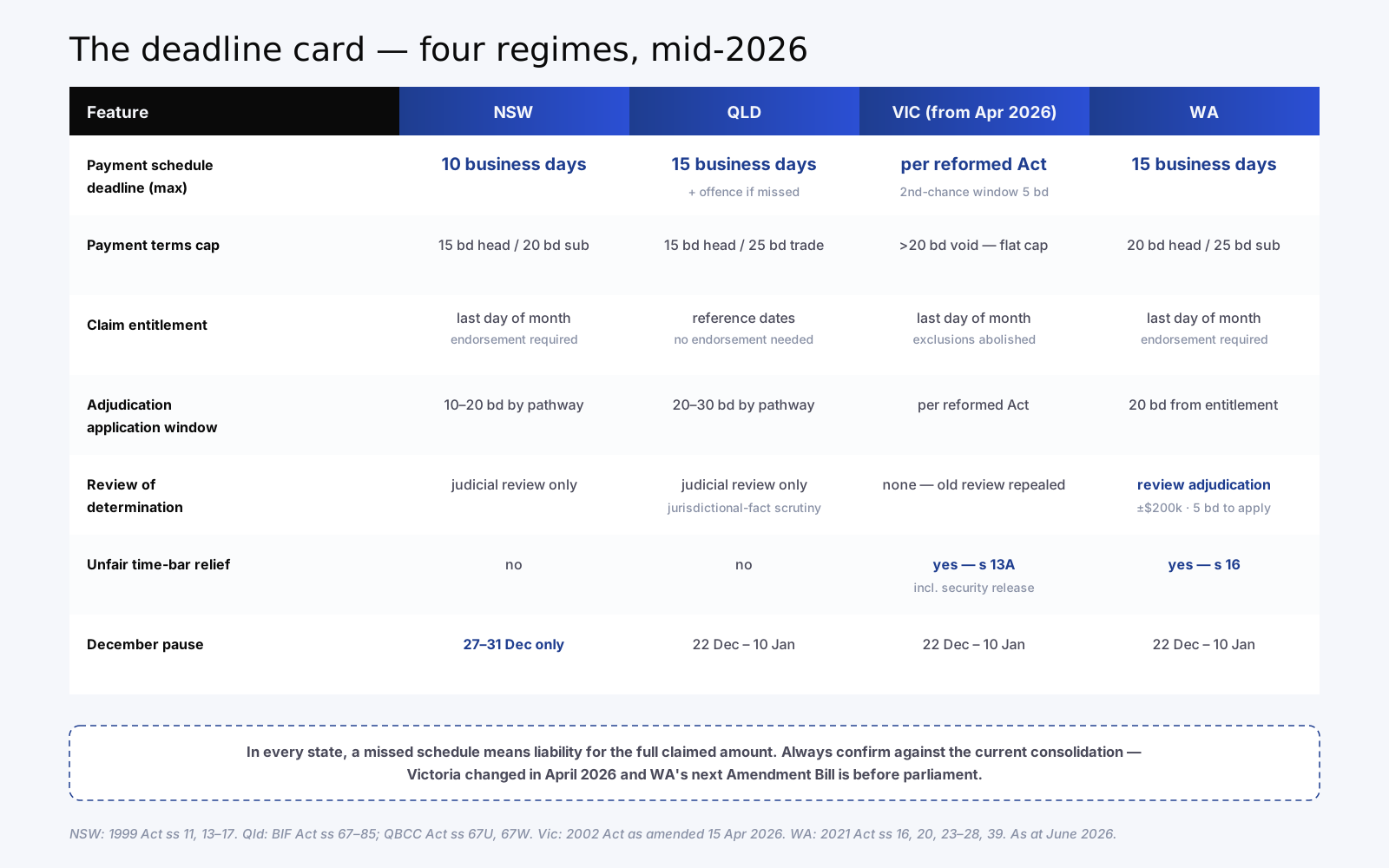
The schedule deadline is the sharpest edge, and it varies. Ten business days in NSW; fifteen in Queensland and WA. A national contractor's shared-services team processing claims on a one-size-fits-all cycle will be early in two states and fatally late in another. In every state the consequence of missing it is the same: liability for the full claimed amount — and in Queensland, missing it is also an offence and forfeits the right to lodge any adjudication response at all (s 82(2)).
Queensland still runs on reference dates. The east-coast states have moved to monthly entitlement, but Queensland kept the reference-date architecture the High Court analysed in Southern Han — with a statutory patch deeming the termination date a final reference date where the contract is silent (s 67(2)). Queensland also doesn't require the "made under the Act" endorsement (an invoice can qualify, s 68(3)), where NSW and WA both do. Teams moving between Brisbane and Sydney misfire on this constantly, in both directions.
The December pause is not uniform. NSW excludes only 27–31 December from business days; Queensland, Victoria and WA all pause from 22 December to 10 January. A claim served into the shutdown behaves completely differently on either side of the Tweed — in NSW the clock restarts on 2 January; elsewhere it sleeps until 11 January.
WA has a second tier no one else has. Western Australia's review adjudication lets either party seek a fresh determination where the gap between positions exceeds $200,000 (with conditions — respondents must have served both a schedule and a response, and must pay the disputed amount into trust). The window is five business days. If you run WA adjudications and don't diarise the review window the moment a determination lands, you're forfeiting a right the other side may exercise.
Unfair time bars can now be attacked in two states. WA pioneered it (s 16); Victoria followed in April 2026 with a broader version (s 13A, extending to security-release notice provisions). In both, the test is whether compliance was "not reasonably possible or would be unreasonably onerous", the declaration operates in the particular case only, and the onus sits on the party alleging unfairness. NSW and Queensland offer nothing comparable — notice discipline remains absolute there.
Queensland treats the payment schedule as a jurisdictional fact. CPB Contractors Pty Ltd v MSS Projects (NSW) Pty Ltd [2025] QSC 239 confirmed that whether a valid payment schedule exists is a jurisdictional fact the court decides for itself under the BIF Act. The court treated it as a jurisdictional fact because, under the BIF Act, a respondent without a valid schedule cannot give an adjudication response at all (s 82(2); CPB v MSS [2025] QSC 239 at [11], applying Melaluca View [2019] QSC 226 at [44]).
Both western and northern regimes are still moving. Queensland paused the further rollout of project trust accounts in early 2025; the proclamation for the next stages was repealed (2025 SL No 3), so those provisions remain uncommenced (BIF Act ch 9 pt 1 divs 3 and 4). WA's Building and Construction Industry (Security of Payment) Amendment Bill 2026 passed the Legislative Assembly in May 2026 and has been at second reading in the Legislative Council since 12 May 2026. It had not passed as at 13 October 2026. Multi-state contract suites need a review trigger when either lands.
What this means in practice
- Run a state-by-state deadline card for every project. One page per jurisdiction: claim entitlement date, schedule deadline, due-date cap, adjudication windows, December pause. Issue it to whoever administers claims, and rebuild it whenever a regime changes: Victoria changed materially in April 2026, and WA has an amendment bill in Parliament.
- Never let head-office habit administer a border-crossing contract. The most expensive errors in this area are imported assumptions: a Brisbane-trained team giving itself 15 business days in NSW, or forgetting the endorsement when it crosses the border south.
- Standardise above the highest bar, not the home bar. If your payment-schedule process reliably delivers in eight business days with every reason particularised, you are compliant everywhere. Building to each state's maximum invites the cross-border slip.
- Pick your battleground when you have a choice. Where a contract spans jurisdictions or the Act's application is arguable, the differences above — review rights, time-bar relief, schedule consequences — are strategic. The same dispute can be materially stronger under one regime than another.
- Watch the reform pipeline. Victoria's April 2026 reset shows how quickly a dormant regime becomes a live one. Treat security of payment law as a moving target with an annual review cycle, not settled knowledge.
Key takeaways
- All four states share the pay-now-argue-later architecture; the deadlines, endorsement rules and December pauses differ enough to be dangerous.
- Schedule deadlines: NSW 10 business days; Qld and WA 15 — with Queensland adding an offence and loss of the adjudication response.
- Distinctive features: Qld reference dates; WA review adjudication and s 16 time-bar relief; Vic s 13A and the statutory security regime; NSW the strictest December calendar.
- Build state deadline cards, standardise above the highest bar, and re-check the consolidations: Victoria changed materially in April 2026, and WA's amendment bill is in Parliament.
This article is general information only and is not legal advice. For advice on a specific contract or dispute, seek legal counsel or contact Sumit Consulting for commercial and claims advisory support.