News & Insights · 5 August 2026 · 5 min read
How to Respond to a Payment Claim in NSW: The Payment Schedule Is Your Recovery Roadmap
Ten business days, one document, and every reason you'll ever be allowed to rely on. The payment schedule deserves more respect than it usually gets.

When a payment claim lands, most respondents treat the response as an accounting task: check the valuation, knock out what isn't agreed, send the number back. That instinct loses adjudications. Under the Building and Construction Industry Security of Payment Act 1999 (NSW), the payment schedule is the single most consequential document a respondent will produce in the entire dispute — because it fixes, permanently, the universe of reasons the respondent may ever rely on. A payment schedule is not just a number: it is the roadmap for your recovery strategy, on either side of the table.
The statutory frame
The respondent has until the earlier of the contractual deadline or 10 business days after service of the claim to provide a payment schedule (s 14(4)) — counted from actual service, not any contractually deemed date (Roberts Co (NSW) Pty Ltd v Sharvain Facades Pty Ltd [2025] NSWCA 161), and on the Act's calendar (business days exclude weekends, public holidays and 27–31 December).
The schedule must identify the payment claim and indicate the amount the respondent proposes to pay (s 14(2)). If the scheduled amount is less than the claimed amount, the schedule must indicate why it is less, and the respondent's reasons for withholding payment (s 14(3)).
The consequences of silence are total: no schedule within time means liability for the full claimed amount (s 14(4)), recoverable as a debt in court where the respondent cannot bring a cross-claim or raise any defence arising under the contract (s 15(4)(b)). A meaningful share of adjudication applications arise where no payment schedule was served at all — an unforced error at industrial scale.
And the rule that shapes everything: in any later adjudication, the respondent cannot include in its adjudication response any reasons for withholding payment not already included in the payment schedule (s 20(2B)). Whatever you forgot, you have lost.
The 24–48 hour triage
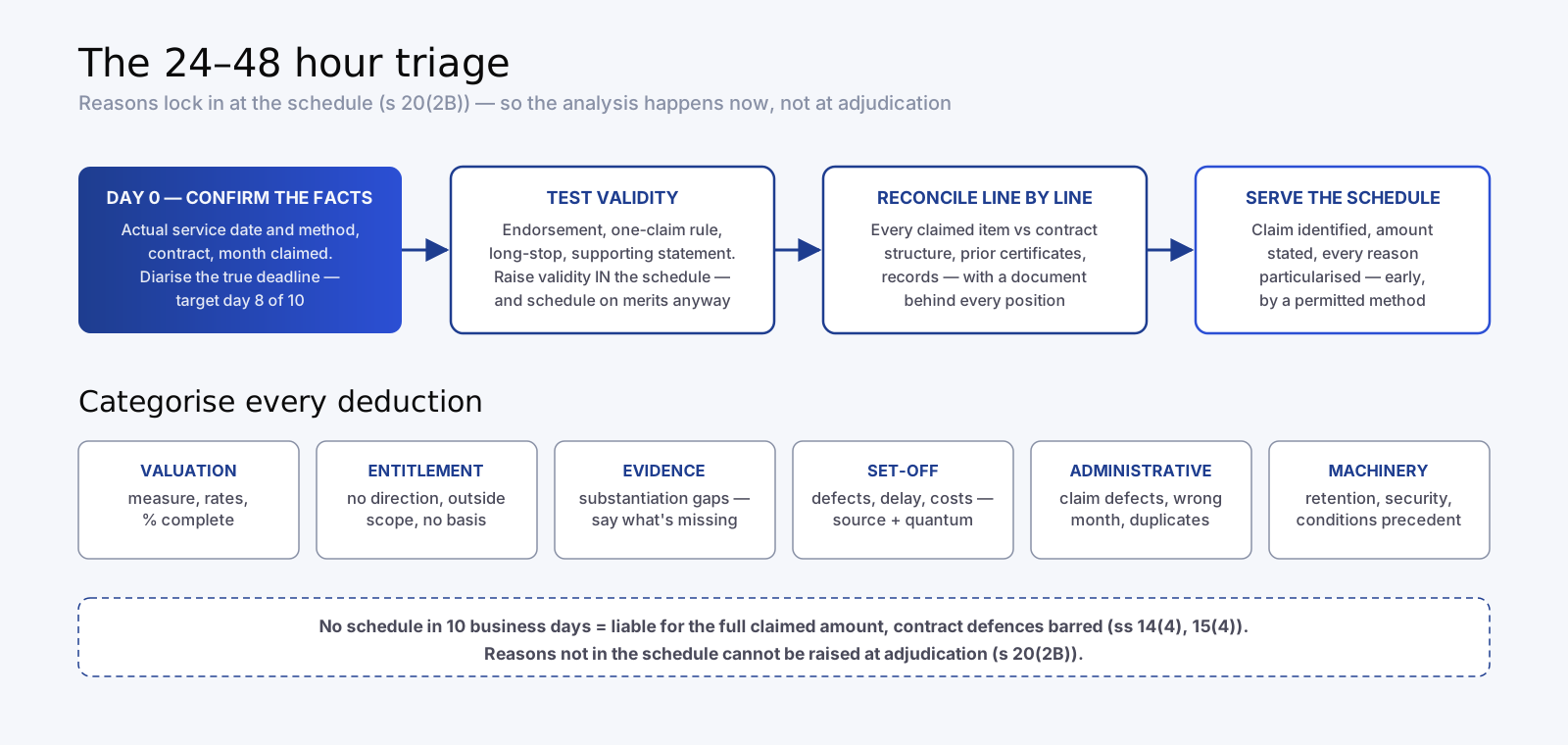
Because the reasons lock in, the work has to happen early. A disciplined respondent triages every claim within a day or two of receipt:
- Confirm the facts. When was the claim actually served, by what method, under which contract, for which month? Diarise the true deadline immediately — and target serving days early, not on the line.
- Test statutory validity. Is it endorsed under the Act? One claim for the month? Within the long-stop? Supporting statement attached (head contract claims)? Validity points belong in the schedule alongside the merits — raising them early preserves them.
- Reconcile line by line. Map every claimed item against the contract structure, prior certificates and the records. The schedule's credibility — and the adjudicator's first impression — is built or destroyed here.
Categorise every deduction
Vague reasons are the respondent's silent killer. "Not substantiated" or "disputed" may technically be a reason, but it hands the claimant an easy adjudication and limits what can be elaborated later. Every deduction should be categorised and particularised. A working taxonomy:
- Valuation — quantum of work performed differs (measure, rates, percentage complete).
- Entitlement — no contractual basis (unapproved variation, work outside scope, no direction).
- Evidence — substantiation absent or inadequate, and what specifically is missing.
- Set-off / back-charge — defects, delay damages, third-party costs: identify the contractual right relied on and quantify it.
- Administrative — claim defects: wrong month, duplicate claim, validity issues.
- Strategic / contractual machinery — retention, security, conditions precedent to payment.
Each category demands different particulars and different evidence. The discipline of sorting deductions this way does two jobs: it forces precision now, and it pre-organises the adjudication response you may need in three weeks.
Writing reasons that survive adjudication
The standard is practical, not forensic perfection — but the reasons must be sufficient to apprise the claimant of the case it will meet. Three habits separate schedules that hold from schedules that fold:
- Particularise to the line item. "Variation 14 rejected — no superintendent's direction under cl 36.1; work outside contract scope per drawing E-103" beats "variations not approved" in every forum.
- Quantify set-offs and identify their contractual source. An unquantified, source-less back-charge reads as leverage, not entitlement — and adjudicators discount it accordingly.
- Include the validity objections. If the claim is defective, say so in the schedule and schedule against the merits in the alternative. Respondents who rely solely on a validity point are betting the project on one argument.
What this means in practice
- Treat the schedule deadline as an operations problem. Inbox and platform monitoring for after-hours service, automatic escalation on receipt, a standing 48-hour triage meeting, and a target of day eight. The $3.2M lesson of Sharvain was process failure, not legal failure.
- Never let a claim pass unscheduled — even when relations are good, even when you intend to pay, even when the claim looks invalid. The schedule costs hours; its absence converts the claim into a judgment debt.
- Build the schedule as the first draft of the adjudication response. Same structure, same categories, same evidence references. If adjudication comes, you assemble rather than create.
- Claimants: read schedules as roadmaps too. A schedule's reasons are the respondent's locked-in case (s 20(2B)). Vague reasons are leverage — they tell you the respondent has not done the work, and they confine what it can argue. Build the adjudication application to answer exactly what the schedule says, and flag everything it doesn't.
- Keep the evidence trail contemporaneous. Every reason in the schedule should have a document behind it — certificates, photos, directions, programme extracts — filed where the adjudication team can find them in week one.
Key takeaways
- 10 business days from actual service, or full liability for the claimed amount with contract defences barred (ss 14(4), 15(4)).
- Reasons not in the schedule are lost forever in adjudication (s 20(2B)).
- Triage within 24–48 hours; categorise every deduction (valuation / entitlement / evidence / set-off / administrative / machinery) and particularise to the line item.
- The schedule is the first draft of the adjudication response — and, read from the other side, the claimant's map of the respondent's entire case.
This article is general information only and is not legal advice. For advice on a specific contract or dispute, seek legal counsel or contact Sumit Consulting for commercial and claims advisory support.