News & Insights · 22 July 2026 · 5 min read
Southern Han: The Reference Date Rule Every Payment Claim Still Lives By
The High Court's only deep ruling on payment claim validity: no reference date, no claim. The 2019 NSW amendments changed the words — not the discipline.

Southern Han Breakfast Point Pty Ltd (in liq) v Lewence Construction Pty Ltd [2016] HCA 52 is the High Court's most consequential statement on the machinery of the security of payment regime — and a case whose central scenario still plays out monthly in Australian adjudications: a contract ends mid-stream, a contractor races out a payment claim for everything done, and the question becomes whether the statute supports the claim at all. The High Court's answer reshaped termination strategy nationally, and although New South Wales has since amended its Act, the decision still governs older contracts, still applies in modified form in Queensland, and still teaches the discipline that decides validity fights.
The facts
Southern Han, the developer, engaged Lewence under an AS 4000-1997 contract to construct an apartment building at Breakfast Point in Sydney. Clause 37 entitled Lewence to make a progress claim on the 8th of each month. The relationship failed in October 2014: Southern Han issued a show cause notice, then — on 27 October — exercised its clause 39.4 right to take the whole of the remaining work out of Lewence's hands. Lewence treated that as repudiation and, the next day, purported to terminate.
On 4 December 2014, Lewence served a payment claim for work performed up to 27 October. It ticked the formal boxes; an adjudicator awarded over $1.2 million. Southern Han attacked the determination on a structural ground: no reference date under the contract supported the claim. Ball J agreed and set the determination aside; the Court of Appeal reversed; the High Court took the case to settle a question on which the Act's whole architecture turned.
The issue
Under s 8 of the Building and Construction Industry Security of Payment Act 1999 (NSW) as it then stood, the statutory entitlement to a progress payment arose "on and from each reference date". Section 13(1) let a person claim who "is or who claims to be entitled" to a progress payment. The question: is the existence of a reference date a precondition to a valid payment claim — or can a claimant simply assert entitlement and leave the merits to the adjudicator?
What the High Court held
A unanimous bench — Kiefel, Bell, Gageler, Keane and Gordon JJ — held that the existence of a reference date under the construction contract is a precondition to the making of a valid payment claim. No reference date, no valid claim, no adjudication jurisdiction.
On the facts, neither of the parties' alternative analyses produced one. If the take-out under clause 39.4 was valid, the contract suspended Lewence's payment rights while the work was in Southern Han's hands — so no reference date accrued on 8 November. If instead Lewence had validly terminated for repudiation on 28 October, termination operated prospectively: only accrued rights survived, and the right to claim for October work would not have accrued until 8 November — after the contract had ended. Nothing in the contract preserved the progress-claim machinery post-termination. Either way, the December claim was unsupported and invalid.
What changed in 2019 — and what didn't
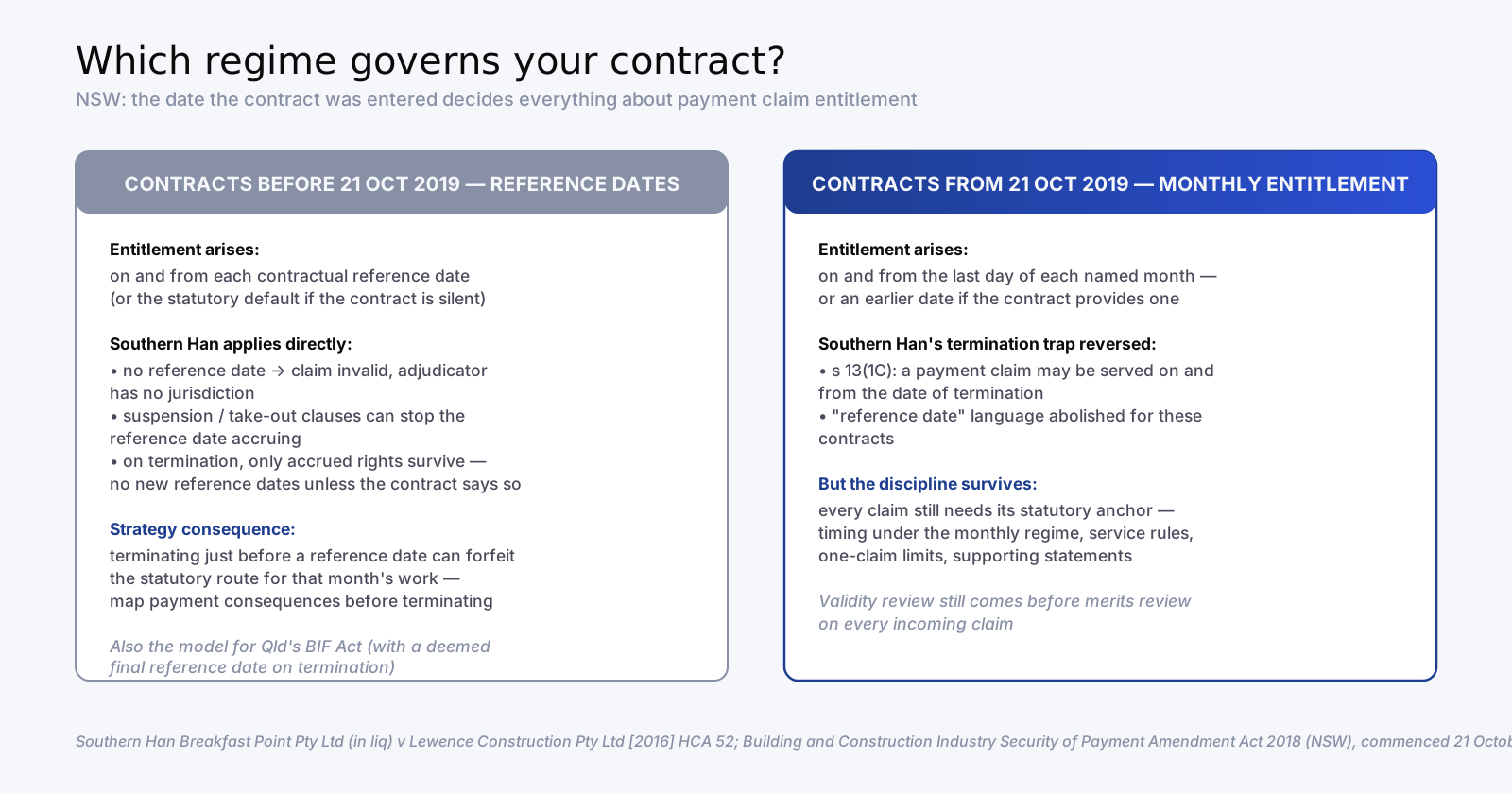
New South Wales legislated directly in response. For contracts entered into on or after 21 October 2019, the amended Act abolished the "reference date" concept: a claimant may serve a payment claim on and from the last day of each named month (or an earlier contractual date), and — reversing Southern Han's termination consequence — expressly permits a payment claim on and from the date of termination (s 13(1C)).
But the decision is far from a museum piece:
- Older NSW contracts — anything entered before 21 October 2019, a category that still includes long-running infrastructure and defects-phase engagements — remain governed by the reference date regime and by Southern Han directly.
- Queensland retains reference dates under the BIF Act, with a statutory patch deeming the termination date a final reference date; Southern Han's reasoning continues to inform how those provisions are read.
- The deeper principle survives everywhere: the statutory entitlement provisions are preconditions, not pleading formalities. The modern validity disputes — timing under the monthly regime, one-claim limits, supporting statements — are decided with exactly the analytical method Southern Han prescribed: find the statutory anchor for the claim, or the claim fails.
What this means in practice
- Date the entitlement before you serve. Every payment claim should be supported by an identified statutory anchor — a reference date under an old-regime or Queensland contract, or the correct monthly/termination trigger under the amended NSW Act. Make it explicit in the claim file, because it is the first thing a well-advised respondent will test.
- Know which regime your contract lives under. A 2018 head contract and its 2022 subcontract sit under different NSW rules. Cross-regime assumptions are a recurring source of invalid claims and missed entitlements.
- Termination timing is payment strategy. Under reference-date regimes, terminating one day before the next reference date can forfeit the statutory route for a month's work. Before accepting a repudiation or exercising take-out rights, both sides should map what the move does to payment entitlements — Southern Han is the case study in getting that sequencing wrong.
- Respondents: validity review comes before merits review. The cheapest complete answer to a payment claim is that no statutory entitlement supports it. The triage sequence for any incoming claim starts with the anchor date, the service rules and the one-claim limits — before a dollar of the valuation is engaged.
- Suspension and take-out clauses carry hidden payment consequences. Clause 39.4-style regimes that suspend payment on take-out were decisive here. Read the consequences provisions of your contract's default machinery — they alter statutory rights in ways that surface only in a crisis.
Key takeaways
- A reference date is a precondition to a valid payment claim under reference-date regimes; its absence deprives the adjudicator of jurisdiction (Southern Han [2016] HCA 52, unanimous).
- On termination, only accrued rights survive — under the old regime, no new reference dates arise unless the contract says so.
- NSW's 2019 amendments (contracts from 21 October 2019) replaced reference dates with a monthly entitlement and allow a claim from termination — check which regime governs each contract.
- The enduring discipline: anchor every claim to its statutory entitlement, and map payment consequences before terminating.
This article is general information only and is not legal advice. For advice on a specific contract or dispute, seek legal counsel or contact Sumit Consulting for commercial and claims advisory support.