News & Insights · 29 July 2026 · 5 min read
Taringa v Kenik: When Courts Will Stay an Adjudication Award Over Claimant Insolvency Risk
Queensland stayed enforcement of a $4.2M adjudication award against a distressed — but not yet insolvent — builder. Two months later, the builder was wound up.

"Pay now, argue later" is the security of payment bargain: the respondent pays the adjudicated amount immediately and recovers any overpayment after final determination. The bargain has a known failure mode — what if, by the time you win the final argument, the claimant has no money to repay? Taringa Property Group Pty Ltd v Kenik Pty Ltd [2024] QSC 327 is Queensland's most significant answer to that question in years: the court stayed enforcement of a $4.2 million adjudication award because of the claimant's perilous financial position, even though the claimant was not yet in liquidation. The sequel proved the point — the claimant was wound up two months later.
The facts
Taringa Property Group engaged Kenik, a Victorian builder, under a design-and-construct contract (August 2020, roughly $13.6 million) for a retail development at Taringa in Brisbane. After the works completed in 2023, Kenik served a payment claim of about $9.7 million; Taringa's payment schedule responded nil. In February 2024 an adjudicator awarded Kenik $4,218,787.02, and the adjudication certificate was filed as a judgment. Taringa paid the amount (with interest and costs) into court and applied on two fronts: to set the determination aside for jurisdictional error — which failed — and for a stay of enforcement pending its substantive proceeding claiming overpayment and damages.
The stay evidence was the heart of it. Kenik had about $9,000 cash at bank. Its claimed net current assets rested on around $2 million of disputed receivables. It carried roughly $7 million in liabilities from completed projects, its QBCC licence had been suspended for failing minimum financial requirements and later surrendered, it had stopped trading, its director was personally funding it, and a winding-up application founded on an unsatisfied statutory demand was already on foot. Hindman J's assessment was blunt: it was difficult to see a path that did not end in external administration.
The issue
Queensland authority — the RJ Neller Building v Ainsworth [2008] QCA 397 line — treats the risk of claimant insolvency during the interim period as a risk the legislation deliberately allocates to the respondent. Stays of adjudication enforcement had been confined to narrow categories: claimants who restructured their finances to defeat recovery, claimants engaged in delaying tactics, or claimants already in liquidation. Kenik was in none of them. The question: can deep financial distress short of liquidation justify a stay?
What the court held
Hindman J granted the stay, on conditions — the first Queensland decision to stay enforcement against a claimant not in liquidation. Most of the discrete factors actually leaned against Taringa: the adjudicator had substantially accepted Kenik's claim on the merits, the strength of Taringa's substantive case was unclear, the Act's policy carries significant weight, and Taringa's own withholding of payment had contributed to Kenik's decline. What carried the day was the core risk: a very high likelihood that, without a stay, the "interim" payment would in substance become final and unrecoverable.
The conditions show the balance being struck rather than abandoned. The adjudication costs component was released to Kenik immediately; a tranche referable to subcontractor charges was preserved; the substantive balance stayed in court pending trial; Taringa was required to top up interest; the usual undertaking as to damages applied; and Kenik had liberty to apply, including in relation to litigation funding.
Then the epilogue. In February 2025, Kenik was wound up in insolvency on the pre-existing creditor's application — over 200 unsecured creditors, more than $10 million owed. And in Taringa Property Group v Kenik [2025] QSC 222, Taringa was refused leave to continue its substantive proceeding against the company in liquidation, being left to the proof-of-debt process. The stay had protected the fund; it could not manufacture a solvent counterparty to litigate against.
What this means in practice
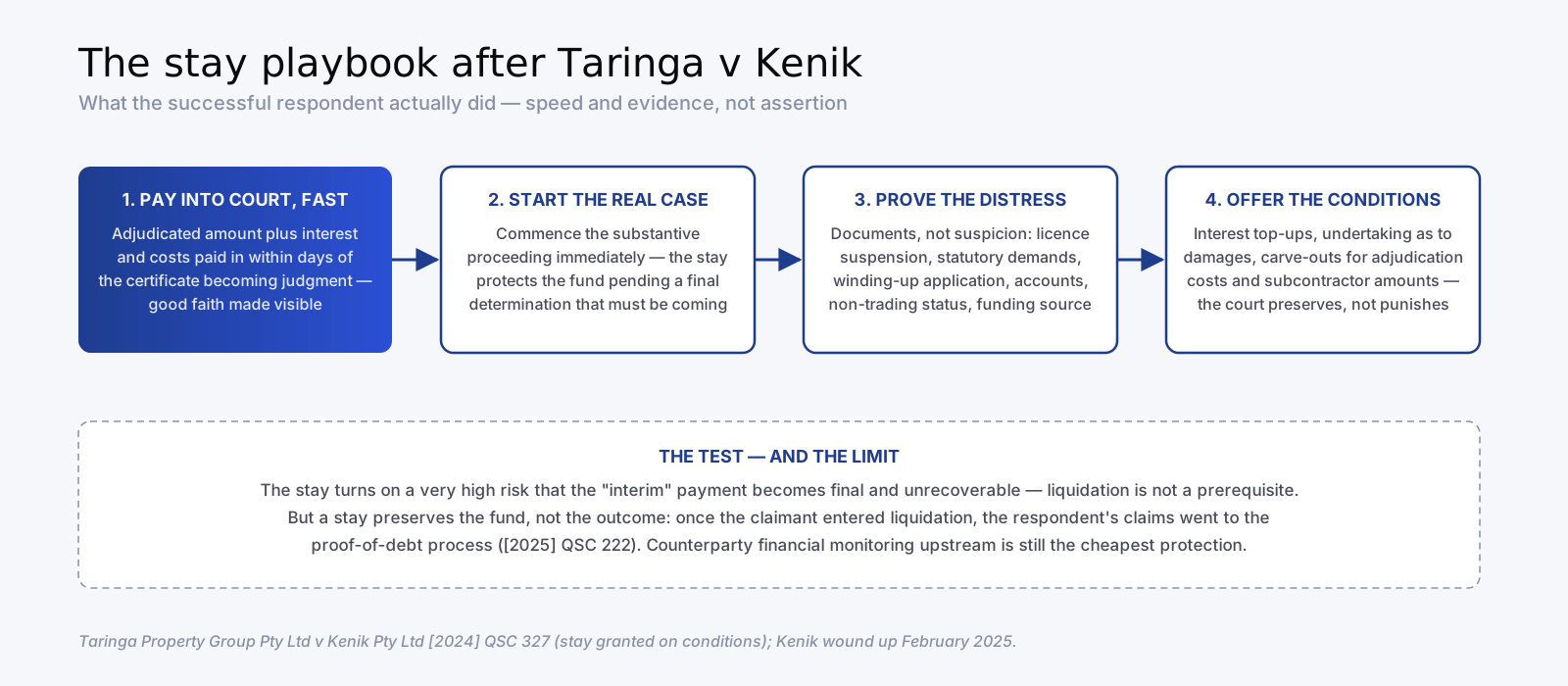
- Respondents facing a distressed claimant now have a real, evidenced pathway. The elements that worked here: pay the adjudicated amount into court promptly; commence the substantive proceeding immediately (the stay protects pending something); and assemble concrete solvency evidence — licence suspensions, statutory demands, winding-up applications, financial statements, non-trading status. Speculation about financial weakness gets nowhere; a documented file changed the law's application.
- Expect conditions, not a free pass. Interest top-ups, carve-outs for costs and subcontractor-bound amounts, undertakings as to damages. The court is preserving a fund, not punishing the claimant.
- Claimants in distress: the decision cuts both ways. Financial difficulty now invites stay applications even without liquidation. Counter-strategies visible in the case: evidence of solvency and trading capacity, the argument that the respondent's own non-payment caused the distress (it weighed in Kenik's favour on the discretionary factors), and targeted carve-outs — costs, funding, subcontractor flows — which Kenik partially obtained.
- The risk allocation conversation belongs earlier. For principals, counterparty financial standing at award and during delivery is the cheapest protection — by the time you are resisting enforcement, the money you are protecting is already at risk. Payment-behaviour monitoring, security adequacy and trust/charge regimes all sit upstream of this fight.
- A stay protects the fund, not the outcome. The [2025] QSC 222 sequel is the sobering coda: once the claimant entered liquidation, the respondent's "argue later" became a proof of debt. Win the stay, but plan the endgame — including what a liquidator does to your cross-claims.
Key takeaways
- Queensland will stay enforcement of an adjudication award where there is a very high risk the claimant cannot repay after final determination — liquidation is not a prerequisite (Taringa v Kenik [2024] QSC 327).
- The respondent's playbook: pay into court, start the substantive case, and prove the distress with documents.
- Conditions follow: costs released, subcontractor amounts preserved, interest topped up, undertakings given.
- The claimant's subsequent winding up — and the refusal of leave to continue against it ([2025] QSC 222) — shows both the stay's value and its limits.
This article is general information only and is not legal advice. For advice on a specific contract or dispute, seek legal counsel or contact Sumit Consulting for commercial and claims advisory support.