News & Insights · 3 August 2026 · 6 min read
What Makes a Payment Claim Valid Under NSW SOPA: A Practitioner's Checklist
Most payment claims that fail don't fail on the merits — they fail on validity. Here is the checklist that keeps a NSW claim inside the Act.

The Building and Construction Industry Security of Payment Act 1999 (NSW) gives contractors and subcontractors the fastest debt-recovery machinery in Australian commerce — but the machine only starts if the payment claim is valid. Validity disputes are where respondents win without ever arguing the merits, and where claimants lose months of cashflow to defects that take minutes to avoid. This is the practitioner's checklist, current for contracts entered into on or after 21 October 2019 (the post-amendment regime; older contracts still run on reference dates — see our note on Southern Han).
Who can claim, and against whom
The entitlement belongs to a person who has undertaken to carry out construction work (or supply related goods and services) under a construction contract — written or oral — and who is or claims to be entitled to a progress payment (s 13(1)). The claim is served on the person liable to pay. Most validity fights at this threshold involve whether there is a "construction contract" at all, or whether the arrangement falls within an exclusion such as s 7(2)(c) — informal development arrangements are dangerous territory on both counts (see Kwik Flo v SE Ware Street Dev [2026] NSWCA 9).
The timing rules
For post-October 2019 contracts, a payment claim may be served on and from the last day of the named month in which the work was first carried out, and on and from the last day of each subsequent month (s 13(1A)) — or from an earlier date if the contract provides one (s 13(1B)). On termination, a claim may be served on and from the date of termination (s 13(1C)).
Three limits sit around that entitlement:
- One claim per named month for work in that month (s 13(5), a default the contract can vary) — though a claim can include amounts from previous months and re-claim previously claimed amounts (s 13(6)). Serving two claims for the same month invites a validity attack on the second.
- The long-stop: a claim must be served within the period allowed by the contract or 12 months after the work was last carried out, whichever is later (s 13(4)).
- Service means actual service. The clock consequences run from when the claim actually arrives — uploaded to the contractual platform, capable of retrieval — and contractual deeming clauses cannot move statutory time (Roberts Co (NSW) Pty Ltd v Sharvain Facades Pty Ltd [2025] NSWCA 161).
The content elements (s 13(2))
A valid claim must:
- Identify the construction work (or goods and services) to which it relates. The standard is reasonable identification — enough for the respondent to understand what is being claimed and assess it. Sloppy identification is among the most commonly argued defects; a claim summary tied to the contract's payment schedule structure, with supporting detail attached, answers it.
- Indicate the claimed amount.
- State that it is made under the Act. The endorsement was reinstated for post-October 2019 contracts (s 13(2)(c)). The safe form of words: "This is a payment claim made under the Building and Construction Industry Security of Payment Act 1999 (NSW)." Put it on the face of the claim, not buried in a covering email.
The supporting statement (head contractors only)
A head contractor must not serve a payment claim on the principal unless it is accompanied by a supporting statement in the approved form, declaring that all subcontractors have been paid amounts due and payable (s 13(7)). Two things practitioners get wrong about it:
- Omission is an offence, not an invalidity. In TFM Epping Land Pty Ltd v Decon Australia Pty Ltd [2020] NSWCA 93, the Court of Appeal held a non-compliant supporting statement does not invalidate the payment claim — the sanction is penal (and the penalties are real: up to 1,000 penalty units for a corporation, with a separate offence for knowingly false statements under s 13(8)).
- It is still not optional. Compliance discipline matters both because of the penalty exposure and because a respondent will happily run the argument and force you to litigate TFM Epping before paying.
What service starts
A valid claim puts the respondent to an election with a fuse of at most 10 business days (shorter if the contract requires): provide a payment schedule under s 14, or become liable for the full claimed amount (s 14(4)) — recoverable as a debt, with the respondent barred from raising contract defences or cross-claims in the recovery proceedings (s 15(4)(b)). And remember the Act's own calendar: "business day" excludes weekends, public holidays and 27–31 December (s 4).
What this means in practice
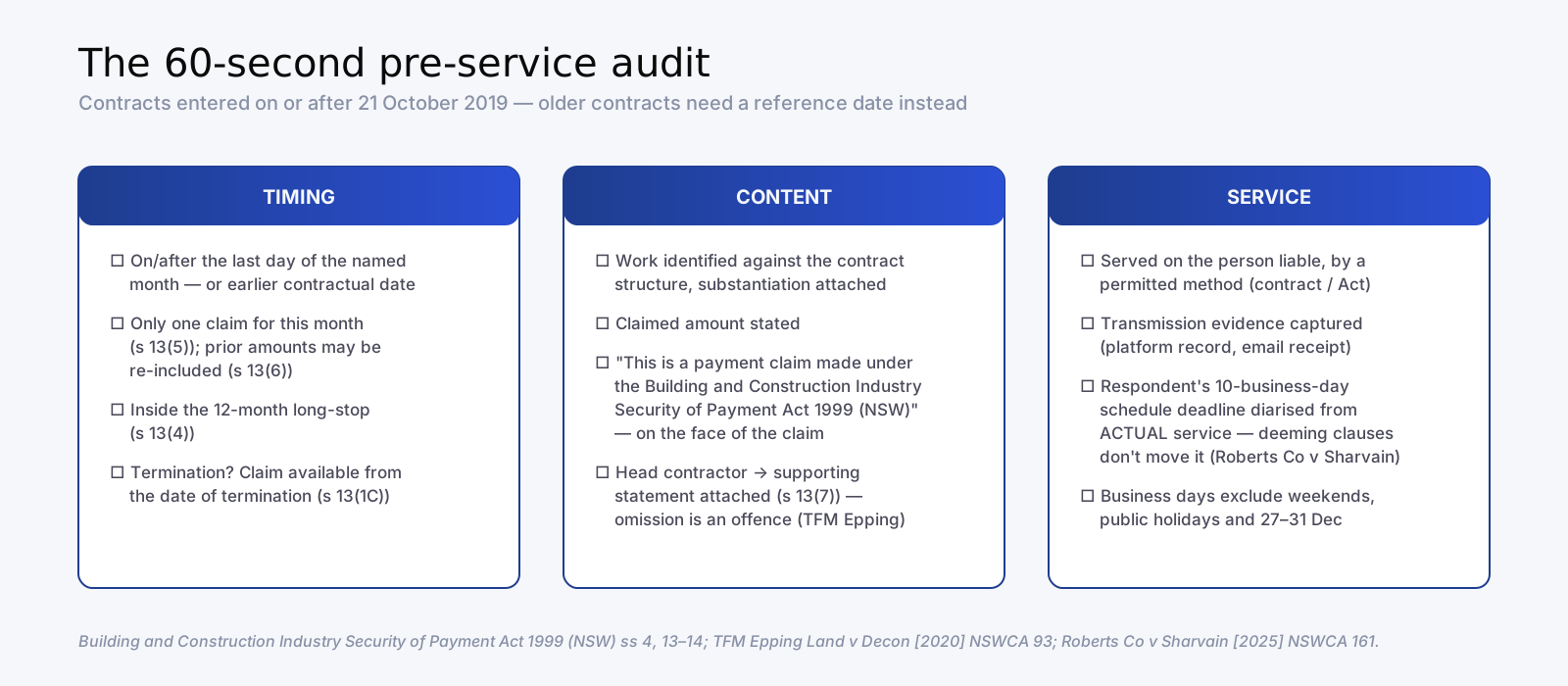
- Run a pre-service validity audit, every claim. Sixty seconds against the checklist: month entitlement, one-claim rule, endorsement on the face, work identified against the contract structure, amount stated, supporting statement attached (head contracts), service method per the contract. Make it a standing agenda item in the monthly claim cycle.
- Build the claim for the adjudication you hope to avoid. A claim that identifies work clearly, with substantiation attached, does double duty: it answers the s 13(2)(a) attack and it becomes the spine of any adjudication application served three weeks later.
- Control the service evidence. Serve by every contractually permitted method, capture the transmission record, and diarise the respondent's 10-business-day schedule deadline from the actual service date — including for claims served after hours or on weekends.
- Don't manufacture validity problems with multiple claims. Where claims need correcting, withdraw and reissue deliberately rather than layering claims in the same month; s 13(5) arguments are a gift to respondents.
- Know which regime the contract lives under. Pre-21 October 2019 contracts still require a reference date (Southern Han Breakfast Point Pty Ltd (in liq) v Lewence Construction Pty Ltd [2016] HCA 52) — the analysis above does not transplant backwards.
Key takeaways
- Validity elements: timing under s 13(1A)–(1C), identification of work, claimed amount, the "made under the Act" statement, one claim per month, 12-month long-stop.
- Head contractors must attach a supporting statement; omission is an offence but does not invalidate the claim (TFM Epping [2020] NSWCA 93).
- A missed payment schedule makes the respondent liable for the full claimed amount with contract defences barred (ss 14(4), 15(4)).
- Time runs from actual service; deeming clauses cannot move it (Roberts Co v Sharvain [2025] NSWCA 161).
This article is general information only and is not legal advice. For advice on a specific contract or dispute, seek legal counsel or contact Sumit Consulting for commercial and claims advisory support.